PLCopen Coding Guidelines preset
PLCopen Coding Guidelines v1.0 is the closest thing the IEC 61131-3 world has to MISRA-C — ~60 rules spanning naming, comments, language constructs, coding practice, and vendor-specific extensions. plc-st-review ships a preset that enforces every PLCopen rule it implements and lays out — in the mapping table below — exactly which rules ship as real, runnable checks and which are out of scope for this tool.
The preset targets the standard, vendor-neutral PLCopen guidelines — no dialect quirks, no vendor idioms — so it works regardless of whether your code is built in CODESYS, TwinCAT, or any other IEC 61131-3 environment.
How to use it
Add to your .plc-st-review.yml:
extends:
  - ./presets/plcopen.yml

# Override anything the preset sets if your team disagrees with PLCopen on
# specific rules — `extends` is a baseline, not a straitjacket.
naming_conventions:
  bool: { prefix: b }    # we use `b` instead of PLCopen's `x` for BOOL

# Or relax a numeric cap.
limits:
  max_parameters: 12
See it in action
A single deliberately-bad function block can trip nearly the entire PLCopen set at once. With the preset enabled, plc-st-review --lint <file> --compact prints one line per finding:
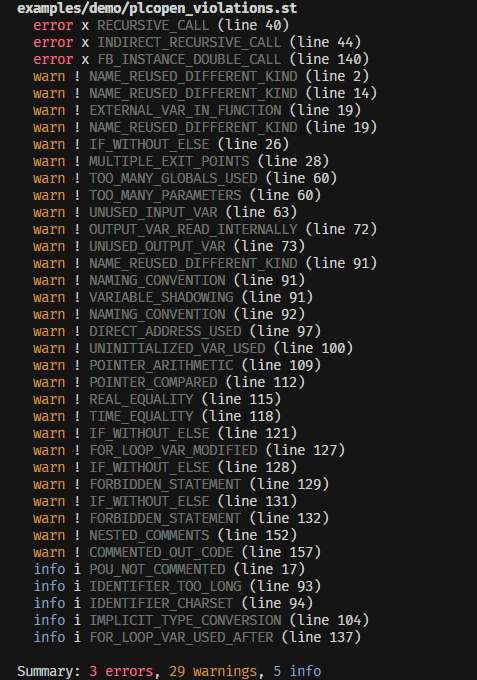
--compact collapses each finding to a single line (severity + category + line); drop it for the full per-finding explanation. This surfaces all 29 single-revision PLCopen checks in one run. Four more — DEAD_POU_INTRODUCED (CP2), COMPLEXITY_INCREASED / NESTING_INCREASED (CP9), UNUSED_VAR_INTRODUCED (CP24), and MULTI_WRITER_GLOBAL (CP26) — are diff- or project-scoped, so they appear in a PR review or with --project-scope, not in a single-file --lint.
What the preset turns on
The preset:
- Enables every PLCopen-aligned check that ships in the engine at the severity PLCopen recommends.
- Sets
metrics.thresholds(cyclomatic complexity 10/20, nesting 4/6) per CP9. - Sets
limitsfor N6 (identifier length 32), CP18 (10 globals per POU), CP23 (8 parameters per POU). - Sets
naming_conventionsfor every dimension (bool →x, int →i, real →r, …; FB-types →FB_prefix; constants →^[A-Z][A-Z0-9_]+$).
Mapping table
Legend:
- mapped — the rule is enforced by a check the preset enables.
- out of scope — the rule's intent is outside what this tool can decide statically (typically: task scheduling, cycle-time semantics, subjective intent rules). These need a different tool or a human reviewer; the preset does not pretend to cover them.
Naming (N)
| Rule | Title | Status | Check |
|---|---|---|---|
| N1 | Avoid physical addresses (%I0.0, %Q1.2) |
mapped | DIRECT_ADDRESS_USED |
| N2 | Define type prefixes for variables | mapped | NAMING_CONVENTION (per-dimension prefixes set) |
| N4 | Constants in UPPER_CASE |
mapped | NAMING_CONVENTION (constant.pattern = ^[A-Z][A-Z0-9_]+$) |
| N5 | Local names shall not shadow global names | mapped | VARIABLE_SHADOWING (→ warn) |
| N6 | Define an acceptable name length | mapped | IDENTIFIER_TOO_LONG (cap via limits.max_identifier_length, default 32) |
| N8 | Define an acceptable character set | mapped | IDENTIFIER_CHARSET (regex via identifier_charset; preset sets the IEC 61131-3 default) |
| N9 | Different element kinds shall not share a name | mapped | NAME_REUSED_DIFFERENT_KIND |
| N10 | Naming rules for user-defined types | mapped | NAMING_CONVENTION (enum_type, structure_type, …) |
Comment (C)
| Rule | Title | Status | Check |
|---|---|---|---|
| C1 | Comments shall describe intent | out of scope | Intent isn't statically checkable. |
| C2 | All elements shall be commented | mapped | POU_NOT_COMMENTED |
| C3 | Avoid nested comments | mapped | NESTED_COMMENTS (→ warn) |
| C4 | Comments may not include code | mapped | COMMENTED_OUT_CODE (→ warn) |
| C5 | Use single-line comments | out of scope | Style preference; a formatter does this better. |
Language (L) — Structured Text
| Rule | Title | Status | Check |
|---|---|---|---|
| L10 | Forbid CONTINUE, EXIT, GOTO |
mapped | FORBIDDEN_STATEMENT |
| L12 | Loop counter shall not be modified inside the loop | mapped | FOR_LOOP_VAR_MODIFIED |
| L13 | Loop counter shall not be used after the loop | mapped | FOR_LOOP_VAR_USED_AFTER (info) |
| L17 | Each IF shall have an ELSE clause |
mapped | IF_WITHOUT_ELSE |
Coding practice (CP)
| Rule | Title | Status | Check |
|---|---|---|---|
| CP1 | Access to a member shall be by name | mapped | DIRECT_ADDRESS_USED (same shape as N1) |
| CP2 | All code shall be used in the application | mapped | DEAD_POU_INTRODUCED (needs --project-scope to see callers outside the diff) |
| CP3 | All variables shall be initialised before being used | mapped | UNINITIALIZED_VAR_USED (source-position heuristic; doesn't model control flow) |
| CP6 | Avoid VAR_EXTERNAL inside function-like POUs |
mapped | EXTERNAL_VAR_IN_FUNCTION |
| CP8 | Floating-point compare shall not be = / <> |
mapped | REAL_EQUALITY (→ warn) |
| CP9 | Limit POU code complexity | mapped | metrics.thresholds (cyclomatic 10/20, nesting 4/6) |
| CP10 | Avoid multiple writes from multiple tasks | out of scope | No task-model awareness in the engine (CP26 covers the related PROGRAM-level case). |
| CP12 | Physical outputs shall be written once per cycle | out of scope | No cycle-time semantics. |
| CP13 | POUs shall not call themselves (direct + indirect) | mapped | RECURSIVE_CALL (direct) + INDIRECT_RECURSIVE_CALL (cycles in the call graph), both → error |
| CP14 | POUs shall have a single point of exit | mapped | MULTIPLE_EXIT_POINTS (→ warn) |
| CP16 | Tasks shall only call program POUs | out of scope | No task-model awareness. |
| CP17 | Parameter usage shall match declaration mode | mapped (partial) | CALL_SITE_OUTDATED catches missing-required and unknown-arg-name cases. Mode-vs-usage finer-grained matching is out of scope for v0.x. |
| CP18 | Limit use of global variables | mapped | TOO_MANY_GLOBALS_USED (cap via limits.max_globals_used_per_pou, default 10) |
| CP20 | FB instances should be called only once per cycle | mapped | FB_INSTANCE_DOUBLE_CALL (→ error) |
| CP21 | Use VAR_TEMP for temporaries |
out of scope | Detecting "which locals could be VAR_TEMP" needs intent / lifetime analysis. |
| CP22 | Select appropriate data type | out of scope | Subjective; depends on application semantics. |
| CP23 | Max number of input/output/in-out variables | mapped | TOO_MANY_PARAMETERS (cap via limits.max_parameters, default 8) |
| CP24 | Do not declare variables that are not used | mapped | UNUSED_VAR_INTRODUCED, UNUSED_INPUT_VAR, UNUSED_OUTPUT_VAR (all → warn) |
| CP25 | Data type conversions shall be explicit | mapped | IMPLICIT_TYPE_CONVERSION (catches INT-family vs REAL-family mix in arithmetic; full type inference is still out of scope) |
| CP26 | A global variable may be written by only one PROGRAM | mapped | MULTI_WRITER_GLOBAL (project-scoped — needs --project-scope) |
| CP28 | TIME equality / inequality shall not be used | mapped | TIME_EQUALITY |
Vendor extensions (E)
| Rule | Title | Status | Check |
|---|---|---|---|
| E2 | Pointer arithmetic shall not be used | mapped | POINTER_ARITHMETIC (tracks POINTER-typed locals across binary + - * /) |
| E3 | Some comparator instructions shall not be used for pointers | mapped | POINTER_COMPARED (relational < > <= >= on POINTER-typed locals) |
Summary
| Bucket | Count |
|---|---|
| mapped (enforced by the preset) | 30 |
| mapped (partial) | 1 (CP17) |
| out of scope (intent / task model / cycle-time semantics) | 5 |
Every rule in the mapped bucket runs out of the box when you extends: this preset; no extra wiring required. The remaining out of scope rules are inherently semantic (CP21 lifetime intent, CP22 type selection) or need a runtime model the engine doesn't have (CP10 task-level concurrency, CP12 cycle-time semantics, CP16 task→POU calls) — they need a different tool or a human reviewer.
The preset closes every PLCopen rule that iec-checker ships, plus the engine's full diff-aware / inline-PR-review / FB-instance / metrics surface on top.
Configurability
The numeric caps and identifier-charset regex are tunable in your own config (or via another preset layered on top):
limits:
  max_identifier_length: 64       # PLCopen N6 — bump this if you have long descriptive names
  max_globals_used_per_pou: 20    # PLCopen CP18
  max_parameters: 12              # PLCopen CP23

# PLCopen N8 — broaden the regex if your team allows extra characters.
identifier_charset: '^[A-Za-z_][A-Za-z0-9_]*$'
Set any limit to 0 (or omit the key) to disable that individual check.
What the preset deliberately does NOT do
- It does not pick a dialect. PLCopen guidelines are vendor-neutral; the preset is too. If you want vendor- or team-specific rules on top, layer them via a second
extends:entry — see Preset packs. - It does not override
case_sensitive. PLCopen doesn't speak to dialect case sensitivity. Setcase_sensitiveto match your toolchain separately. - It does not pretend to enforce every PLCopen rule. The 8 "out of scope" rows are honest: they need a runtime model, type inference, or human judgement this tool doesn't have.