IEC 62443 mapping (industrial cybersecurity)
IEC 62443 is the international standard series for cybersecurity of industrial automation and control systems (IACS). It is the OT-security counterpart to IEC 61508's functional safety: where 61508 asks "could this system fail in a way that hurts someone?", 62443 asks "could this system be made to fail by an attacker?".
The 62443 series defines Security Levels (SL) 1–4 (analogous to SIL 1–4) and breaks into Parts 1 (concepts), 2 (policies & procedures), 3 (system requirements), and 4 (component requirements). The parts most relevant to a source-code analyzer are:
- 62443-4-1 — Secure product development lifecycle requirements. Process for developing secure IACS components. Includes SI (Secure Implementation), SD (Secure Design), SVV (Security Verification & Validation), DM (Defect Management), SUM (Security Update Management).
- 62443-4-2 — Technical security requirements for IACS components. What the component itself must do. Organised into seven Foundational Requirements (FRs).
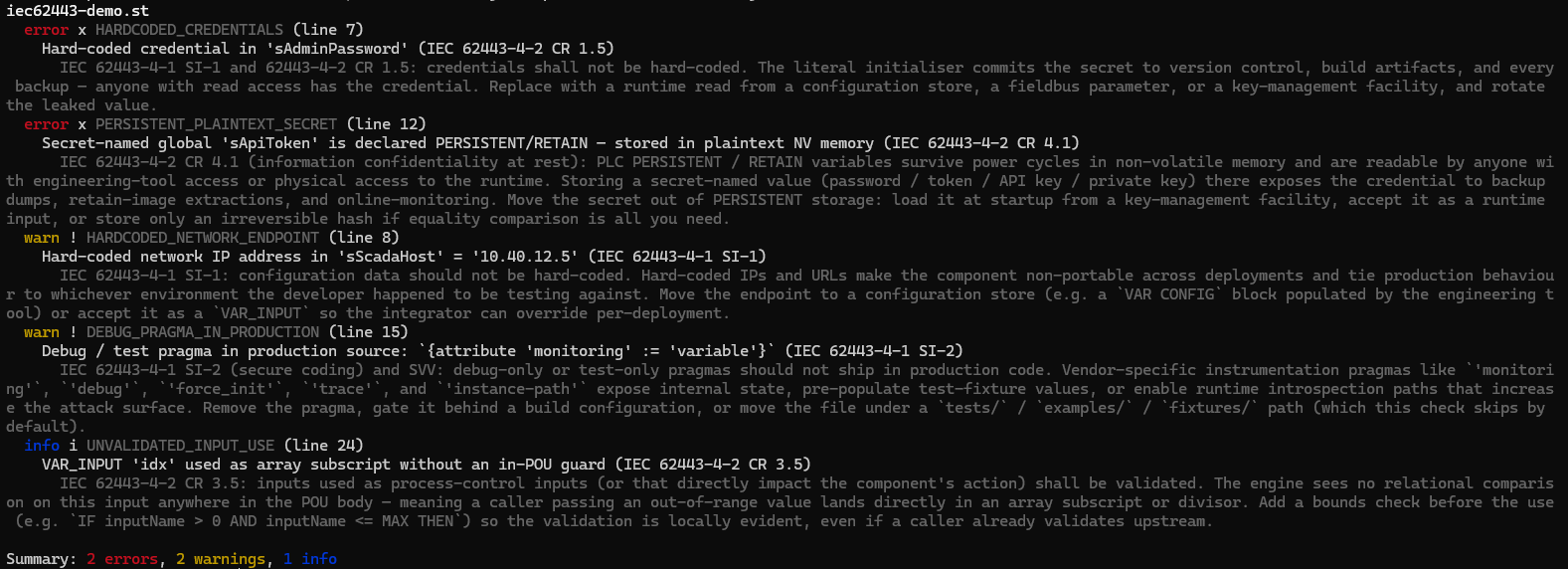
plc-st-review is the first OSS PLC linter to ship checks explicitly targeting IEC 62443 concerns (to our knowledge — if you know of another, please open an issue and we'll cite it here). The five new categories cover the slice of 62443 that is actually statically inferable from ST source; the rest of 62443 is runtime / process and remains out of scope.
[!important] Same caveat as the IEC 61508 page:
plc-st-reviewis not a TÜV-certified security tool. This page positions where the engine can contribute to a 62443 secure-development process. Vendor- and integrator-side qualification activities are still required for SL-rated products. The 61508 page has a longer explanation of what TÜV / Tool Class qualification actually means — the same model applies to 62443's security-context Tool Confidence / Qualification expectations.
What this page is — and is not
- It is a mapping from
plc-st-reviewchecks to the 62443-4-1 and 62443-4-2 clauses they help satisfy. - It is honest about scope: most 62443 requirements (FR1 auth, FR2 use control, FR3 system integrity at runtime, FR4 confidentiality of comms, FR5 restricted data flow, FR6 timely response to events, FR7 resource availability) cannot be verified by source-code analysis and live outside any linter. The 62443 mapping has fewer green cells than the PLCopen or MISRA mappings — that's structural, not a gap.
- It is not a claim that running
plc-st-reviewmakes a component 62443 SL 1 / SL 2 / SL 3 / SL 4 compliant. SL claims attach to systems and processes, not tools.
62443-4-1 — Secure development lifecycle
| 62443-4-1 practice | Contributing plc-st-review checks |
|---|---|
| SD (Secure Design) — SD-3 Defense in depth | POINTER_ARITHMETIC, POINTER_COMPARED, ADDRESS_OF_CONSTANT, MULTI_WRITER_GLOBAL — limit the attack surface and the blast radius of a single defect. |
| SI (Secure Implementation) — SI-1 Security requirements implementation | HARDCODED_CREDENTIALS, HARDCODED_NETWORK_ENDPOINT — coding practices that prevent leaking secrets / endpoints into version control. |
| SI (Secure Implementation) — SI-2 Secure coding standards | DEBUG_PRAGMA_IN_PRODUCTION, FORBIDDEN_STATEMENT (gated on GOTO), RECURSIVE_CALL, INDIRECT_RECURSIVE_CALL, MULTIPLE_EXIT_POINTS, UNINITIALIZED_VAR_USED, IMPLICIT_TYPE_CONVERSION, REAL_EQUALITY, BOOL_COMPARISON, ASSIGNMENT_IN_CONDITION — secure-coding hygiene that 62443-4-1 expects every component to follow (the standard explicitly names MISRA, CERT, and equivalent — see MISRA mapping for the rule-level cross-reference). |
| SVV (Security V&V) — SVV-3 Vulnerability testing — static code analysis | The entire engine — every category, treated as a static-analysis input feeding SVV evidence. |
| DM (Defect Management) — DM-1 Receiving notifications of security-related issues | (Out of scope — process activity.) |
| SUM (Security Update Management) — SUM-1 Security update qualification | (Out of scope — process activity.) |
62443-4-2 — Component requirements
The seven Foundational Requirements (FRs) of 62443-4-2 cover runtime behaviours of an IACS component. Most are not statically inferable from ST source; the table below covers only the clauses where static analysis genuinely helps.
FR 1 — Identification and authentication control
| Component Requirement | Contributing checks |
|---|---|
| CR 1.5 Authenticator management — credentials shall be stored protected from unauthorised disclosure | HARDCODED_CREDENTIALS — flags secret-named variables initialised with a literal STRING value (the most common variant of stored credential leak). |
FR 3 — System integrity
| Component Requirement | Contributing checks |
|---|---|
| CR 3.4 Software and information integrity | UNINITIALIZED_VAR_USED, ASSIGNMENT_IN_CONDITION, ARRAY_INDEX_OUT_OF_BOUNDS, DIVISION_BY_ZERO — defects that allow corrupted or unexpected state to flow into the runtime. |
| CR 3.5 Input validation | UNVALIDATED_INPUT_USE — VAR_INPUT used as array subscript or divisor with no in-POU relational guard. |
FR 4 — Data confidentiality
| Component Requirement | Contributing checks |
|---|---|
| CR 4.1 Information confidentiality at rest | PERSISTENT_PLAINTEXT_SECRET — VAR_GLOBAL PERSISTENT / RETAIN of secret-named values (the data lives in NV memory and is readable through engineering-tool access). |
FR 2 / FR 5 / FR 6 / FR 7 — out of scope
These cover use control (access control on the runtime), restricted data flow (network segmentation), timely response to events (audit logging), and resource availability (DoS resistance). They are runtime properties of the component and its host environment, not source-code properties — plc-st-review makes no claim against them.
The five new IEC 62443 checks
All five categories ship at v0.2.2 and are off-by-default in spirit (any project can disable them via disabled_checks), but they run on every push by default:
| Category | Severity | Maps to | Doc |
|---|---|---|---|
HARDCODED_CREDENTIALS |
error |
62443-4-2 CR 1.5 | Check page |
HARDCODED_NETWORK_ENDPOINT |
warn |
62443-4-1 SI-1 | Check page |
UNVALIDATED_INPUT_USE |
info |
62443-4-2 CR 3.5 | Check page |
DEBUG_PRAGMA_IN_PRODUCTION |
warn |
62443-4-1 SI-2 | Check page |
PERSISTENT_PLAINTEXT_SECRET |
error |
62443-4-2 CR 4.1 | Check page |
The three error / warn categories block CI by default at fail_on_severity: error / warn. UNVALIDATED_INPUT_USE ships at info because its heuristic does not see caller-side validation (see the check's Limits section) — promote it to warn with severity_overrides once your team agrees on the "validate in the POU even if a caller already did" posture.
Suggested severity policy by Security Level
If you are running plc-st-review on a component that will be assessed at an IEC 62443 SL band, a reasonable starting point — adjust to your safety / security case:
| Target SL | Suggested policy | Notes |
|---|---|---|
| SL 1 | fail_on_severity: error |
Block on HARDCODED_CREDENTIALS and PERSISTENT_PLAINTEXT_SECRET. UNVALIDATED_INPUT_USE stays advisory. |
| SL 2 | fail_on_severity: warn; promote UNVALIDATED_INPUT_USE to warn |
Block on the network-endpoint and debug-pragma findings too. |
| SL 3 | fail_on_severity: warn; promote UNVALIDATED_INPUT_USE to error |
Plus add a manual code-review gate for every info finding — your assessor will want documented disposition. |
| SL 4 | All checks error |
Combined with a TÜV / TCL-qualified primary toolchain — plc-st-review is a supplementary input at this band, not a primary qualifier. |
Limits of this mapping
- The engine has no model of the runtime — no view of authentication paths, no view of which
VAR_INPUTis reachable from a network endpoint vs. only from another POU, no view of the cycle-time / task model. The 62443 mapping is necessarily structural ("this shape of code is a known hazard") rather than flow-sensitive ("this specific data path is exploitable"). - The check set is not exhaustive. There are 62443 requirements with no current static analog in the engine (e.g. CR 3.1 communication integrity, CR 2.x use control, FR 6 audit logging). Future versions may add more checks as static heuristics for them become practical.
- The 62443 mapping is vendor-neutral. It does not target any specific vendor's runtime model (CODESYS, TwinCAT, GX Works, etc.). Vendor-specific cybersecurity guidance (e.g. Beckhoff's "TwinCAT 3 Security Guidelines") is a complementary input, not a replacement.
If you are starting a 62443-rated project that wants to use this tool
- Read the Deterministic by design page — auditability and reproducibility are the same requirements 62443 SVV asks for.
- Read Check limitations — the documented blind spots are the starting point for your tool-qualification evidence.
- Read Tuning severities and pin a
severity_overridespolicy matched to your target SL band. - Pin a specific release of the tool (via the npm package or Docker image tag); document the version; treat upgrades as configuration changes subject to your change-control process.
- Treat this page as a positioning document, not as qualification evidence. Independent tool qualification is the integrator's responsibility.
For everything beyond that, talk to your assessor.